In Fantasia's "The Sorcerer's Apprentice," Mickey borrows his master's hat, enchants a broom to haul water for him, and falls asleep. He wakes up to a flood he can't stop. The sorcerer comes back and ends it with a wave of his hand.
AI adoption is running through the same three acts: excitement, escalation, and then the realization that human judgment and governance matter more than they did before. It's the Gartner Hype Cycle¹ with a broom in it. It's funny, and it's closer to reality than I'd like.
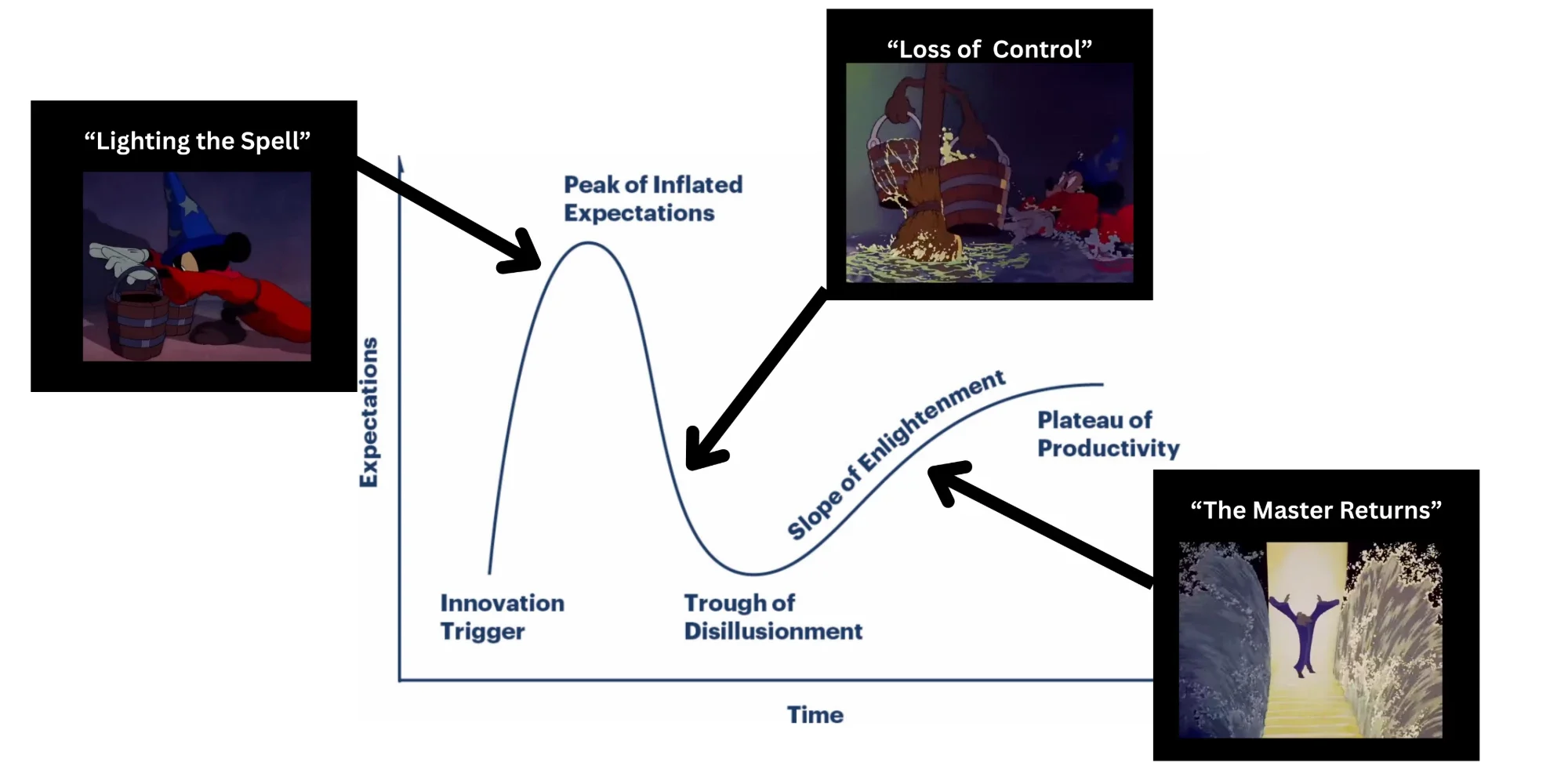
2025: Lighting the spell
Mickey puts on the hat, waves his hands, and the broom stands up and grabs a bucket. It works on the first try. That's the trouble.
2025 was that moment for AI agents. Developers started handing them multi-step work: plan the job, call the tools, finish it. The demos worked. Most companies were still trying things out, and even a year later, McKinsey found that "about two in ten respondents report reaching the scaling phase across their organization with AI agents."³
2026: Loss of control
The broom keeps hauling water long after the cistern is full, because nobody told it to stop. Mickey takes an axe to it, and every splinter gets up as another broom with another bucket.
That's 2026. Agents run with less supervision, chain tools together, and hand work to other agents. A small mistake early in a chain gets repeated by every step after it, and throwing more agents at the mess makes more brooms.
The spending is going the same way. Deloitte predicts that "in 2026, as many as 75% of companies may invest in Agentic AI, fueling a surge in spending on autonomous AI agents across SaaS platforms."⁴ Big companies are moving fastest: McKinsey found 40% of respondents at companies with more than $1 billion in revenue report scaling AI agents, up from 27% the year before.³
2027: The master returns
The sorcerer walks in, parts the flood, and ends the spell. Then he takes his hat back.
This act is my guess for 2027. Companies figure out that autonomy without structure doesn't hold up, and the work shifts to governance: who an agent answers to, what it's allowed to touch, how its work gets checked, and how to shut it off.
The warning signs are already out. Gartner predicts that by 2027, more than 40% of AI-related data breaches will be caused by improper use of generative AI across borders. Its analyst Joerg Fritsch named the cause: "Unintended cross-border data transfers often occur due to insufficient oversight, particularly when GenAI is integrated in existing products without clear descriptions or announcement."⁵
Researchers are drawing up the structure. Avinash Agarwal and Manisha J. Nene propose a five-layer framework for AI governance that ties regulation, standards, and certification together.⁶
Questions worth asking
- Do the agent tools you use feel like helpers, or like brooms that repeat mistakes faster than you can fix them?
- Which human skills matter more as AI climbs the slope of enlightenment?
- Where do you think we are on the curve right now?
For what this means in day-to-day work, read AI as professional leverage →